
My father wasn’t a warm man, nor was he particularly cold. His presence was a bit nebulous. In his mid to late seventies though, he changed. That decade he started to hug me back, sometimes lingering longer than I was comfortable. That was the first – and sadly last – time I heard him say he loved me.
I just entered my sixties. Very few people leave their sixties in the same vocation as they entered it. There can be a panic – a low grade urgency – that the highpoint of your success is behind you. But another voice is becoming louder, “Your success won’t be measured by your achievement but by your investment in others.”
A friend shared a quote with me that embodies that growing voice:
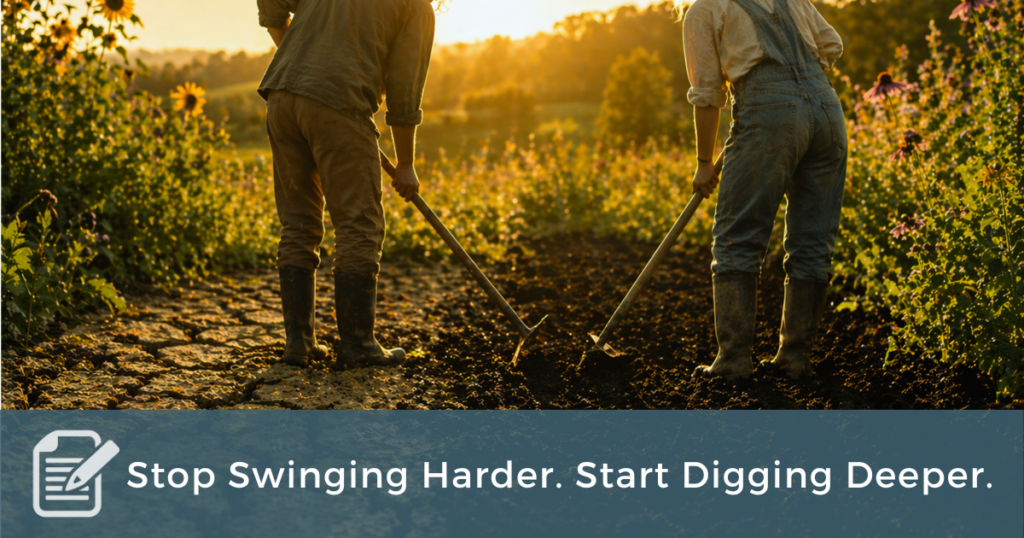
“We are exploring together. We are cultivating a garden together, backs to the sun. The question is a hoe in our hands and we are digging beneath the hard and crusty surface to the rich humus of our lives.” – Parker J. Palmer, Let Your Life Speak: Listening for the Voice of Vocation
How We Work – “The question is the hoe”
I remember being in a meeting where I vehemently disagreed with the leader. I passionately began laying out my argument, and as I looked across the table at my best friend, he was giving me the clear “shut it down” signal. I was expecting to get the “go” sign that rooted for me to “round the bases, but clearly this was not a homerun.
No one was listening to my passionate argument. In fact, they were digging into their predetermined beliefs. I was having zero impact.
After I received some training as a coach, I began to show up differently in meetings. My questions became open ended and reflective. Everyone was encouraged to participate in the conversation, and the obstacles tended to become much more clear. There was room for a bit of truth to be injected into the dialogue. We started to move forward with clear, healthy steps.
Telling people what they should think bounces right off. You might even reinforce their current beliefs by the effort of trying to change them. Perhaps my most shocking discovery about coaching is that when people are given an honest and safe chance to reflect, they lean toward what is healthy and good.
Where We Work – “Digging beneath the hard and crusty surface”
There is a rich smell that rises from a freshly plowed field. It smells like an invitation. “Go ahead. Plant something here.” What previously looked like a dry field, once turned, has a rich, fertile, moist soil that seemingly longs to be put to good work. The farmer’s key knowledge is that he must first put a hoe to the soil. This is the work Palmer is describing.
In the TV show Ozark, a financial advisor drags his family into a dangerous web of crime and survival after laundering money for a Mexican drug cartel goes wrong. One particularly notable character is a priest, whose parish appears to be the cartel itself. Initially we are suspicious of his motives, but he appears to be noble and good. The protagonist asks him why he is there amongst such evil people. His response is simple, “This is where I am most needed.”
That line has stuck with me. Sometimes we think of coaching as only available to us when we get some clients. But I have found that the coaching mindset is always helpful when there is a “hard and crusty surface” to the issue at hand. This is almost always the case. The impulse is to swing harder. This rarely works. We look more like we’re trying to kill a snake than turn the dirt.
Coaches work where they see the most need. And the need is everywhere.
Why We Work – “To the rich humus of our lives.”
I know lots of people who are afraid to look inside. They think they will only see failure inside. This can come from inattentive parents. It can come from the result of really poor decisions. The surprising truth is that when you break through the hard crust of a human life, you will always release a rich wonder which is the soul of a human being.
In Father Greg Boyle’s Ted Talk, he shares about how he sees transformation of gang members, finding dignity, connection and healing. He is asked, “Does this always happen?” We’re expecting him to say, “No,” but he doesn’t. He pauses and quietly says, “Yes.” The fact that we are troubled by his answer speaks volumes to our understanding of humanity.
Father Boyle understands the work of the hoe. So does the fictional priest in the TV show. For me, learning about coaching has been that moment when someone handed me a hoe and said, “This is the most important tool we have for bringing the Kingdom of God.” I’m sure I’m biased, but I may also be right.
There is no more important work than helping others uncover what is already within them and move forward.
Conclusion
What if the problem isn’t that people lack depth—but that we rarely take the time to uncover it?
We live in a world that rewards speed, certainty, and surface-level answers. But the work that actually changes people is slower. It requires questions, patience, and the willingness to believe that beneath even the hardest surface, something good is waiting to be found.
That changes how we show up.
We begin to use coaching skills not as techniques, but as an expression of belief—that people are not problems to be solved, but lives to be explored. And we begin to create cultures where reflection is not a luxury, but a necessity.
Because when we do, something remarkable happens.
We discover that Father Boyle was right.
It does happen. Not occasionally. Not exceptionally.
But consistently—when someone is willing to pick up the hoe and start digging.