
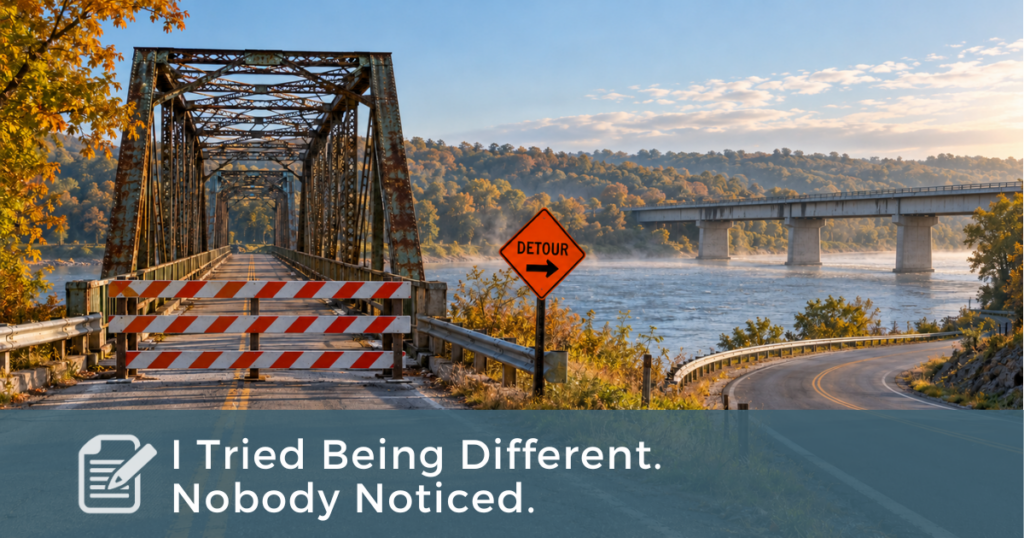
I live near two major dividers. One is Interstate 70. If you want to drive north of our small town, you have to cross a divided highway where traffic never stops. The way across is an overpass, and you can find one every five to ten miles. Unfortunately, the most convenient one for me seems to be closed about half the time.
The other major divider is the Wabash River, which separates Illinois from Indiana. It isn’t the Mississippi, but you still can’t easily cross it. Bridges can be thirty or forty miles apart along stretches of the river. If your usual crossing is closed, you may have an hour detour. People get pretty rooted in the way they travel.
The same is true of the way people navigate relationships. People learn where they can approach you, what will get them across, and which routes are likely to end badly. Over time, those familiar crossings become the way they relate to you.
Then you decide to change.
Perhaps you’ve realized that you push too hard in conversations. Or you withdraw whenever someone disagrees. You discover another way to respond and decide to try it. This is good news, but the people around you still head toward the same old crossing. You’ve opened another route, and they don’t yet know it exists.
Changing how you show up doesn’t immediately change what other people expect from you.
An example comes from the Thomas-Kilmann Conflict Mode Instrument, or TKI. It describes two dimensions of our approach to conflict. I think of them as levers. We can be more or less assertive in pursuing our own concerns, and we can be more or less cooperative in addressing the other person’s concerns. Those two levers give us five approaches: competing, avoiding, accommodating, compromising, and collaborating.
All five can be useful. Most of us, however, become comfortable with one or two and use them in nearly every situation. Sometimes what makes us “difficult” is that we keep using an approach that doesn’t fit what is needed.
I was reviewing TKI with a student in CAM 509 Using Assessments in Coaching. Her primary approaches were competing and avoiding. She could push hard for what she wanted, or she could back away from the conversation. Both approaches are low in cooperativeness. She was moving the assertiveness lever between its extremes while leaving the other lever largely untouched.
Then she realized she had another option. She could become more cooperative without necessarily becoming less assertive. She could care about what mattered to the other person while continuing to care about what mattered to her.
This is a wonderful realization! But I observed that the people around her might need some time to recognize what she was doing. If they were accustomed to her competing or avoiding, they might interpret her new behavior through those familiar expectations.
As coaches, we can help clients prepare for this part of change. I can think of three supports they will need.
A Determination to Show Up Differently
A familiar route is easy to follow, especially when we are frustrated. We may enter a conversation determined to cooperate, only to discover that the other person is already braced for an argument. Their defensiveness brings out ours, and soon we’re back in the conversation we intended to change.
This is where a client needs more than a good intention. What will help them remember the choice they want to make? What could become a reliable trigger for a different response? How will they reflect on what happened and prepare to try again?
Frustration accompanies change, especially when our effort doesn’t produce an immediate improvement. We may think, “I tried cooperating, and it didn’t work.” But the other person may need more than one experience before they believe we are approaching them differently. Our client will need support to persist long enough for a new pattern to become possible.
A Willingness to Practice Nuance
Discovering another lever doesn’t mean we know how to use it. At first, we may only be able to turn it all the way on or all the way off. No nuance. Someone who is learning to cooperate may agree too quickly, ask too many questions, or become so concerned with understanding the other person that they never express their own concerns.
It takes practice to develop range. How do I listen carefully and still say what I need? How do I make room for your concerns when I disagree with your proposed solution? How do I remain engaged when backing away would be easier?
With practice, probably more than we expect, we begin to make those adjustments more naturally. The rough edges start to fall away. We become more capable of choosing an approach that fits the situation instead of reaching for the same familiar response.
As coaches, we can help clients rehearse a conversation, reflect on an attempt, and identify one adjustment for next time. They don’t have to master the lever before they use it. Using it is how they learn.
A Commitment to Retraining Others
Think about that river crossing again. I need a detour sign. I’m happy to go a different way, but I don’t want to have to guess. The next bridge may be forty miles down the river. If you’ve opened a better crossing, please tell me where it is.
If I’m going to start cooperating, I may simply need to tell my conversation partner what I’m doing. “I know I usually push for a decision here. I still have an opinion, but I want to understand what matters to you before we decide.”
That gives the other person something useful. They don’t have to guess whether my questions are a setup for an argument or whether my listening means I’ve abandoned my position. I’m helping them understand how to participate in this unfamiliar conversation.
There is some humility required here. I’m practicing a new skill, and they may need time to trust it. I can explain what I’m trying to do, invite their participation, and keep showing up consistently.
These three supports can help a change take hold: determination to continue, practice to develop skill, and communication to help others recognize what is happening. As a coach, I can help my client build all three into the plan.
Opening a new crossing is a good beginning. Helping people find it is part of the work.

