
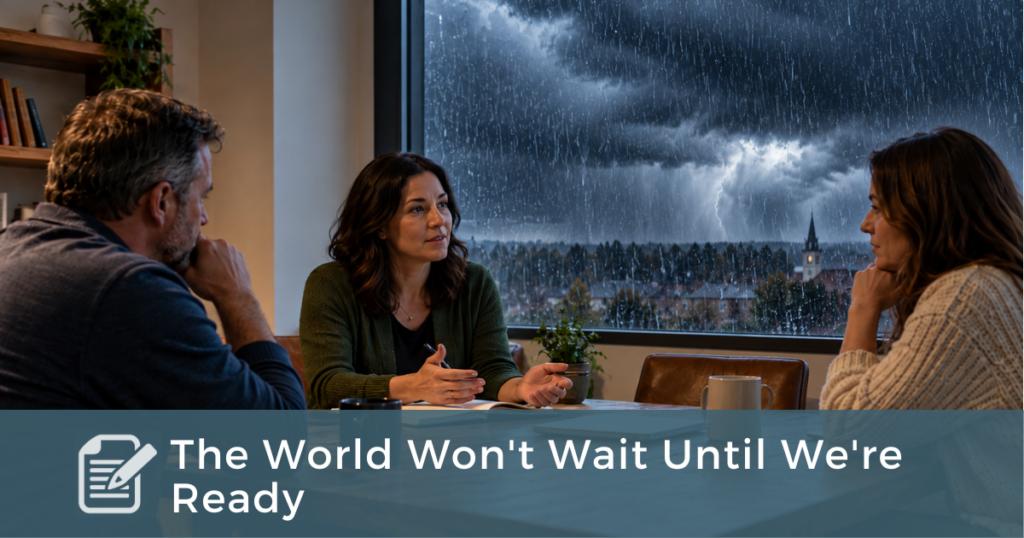
Last week, we had our quarterly trainer meeting at Coach Approach Ministries. Danelle and I were walking our trainers through what seems like an infinite list of changes being handed down to us from the International Coaching Federation (ICF). Some of these changes are going to be painful. They will require us to rethink how we do things, develop new processes, and spend time and energy that we don’t necessarily have.
Don’t misunderstand me. Some people are fighting these changes. Others are questioning the legitimacy of the ICF itself. I’m not doing either of those things. I understand that standards need to evolve. But that doesn’t make the changes any easier to swallow.
I started the meeting by talking about an old principle of leadership that I learned from Ronald Heifetz and Marty Linsky. The idea was that leaders should push their organizations to change at the maximum rate people could tolerate. That was probably faster than either the leader or the people thought possible. But there was a limit. Push beyond that limit and people would break, revolt, or worse.
It was good advice. I used it for years. But I wonder whether that principle is sufficient for the world we’re living in now.
When change exceeds our capacity
For at least the last couple of years, we’ve been living in a world where change is coming faster than most of us can absorb it. And unlike the organizational changes Heifetz and Linsky were addressing, much of this change isn’t being initiated by our leaders. It’s being forced upon us from the outside.
I remember consulting with a church whose pastor had died during COVID. The church was already struggling, and the loss of their pastor had left them near death themselves. After spending time with them, I suggested that they consider closing the church with dignity and celebration. They could honor everything God had done through that congregation rather than simply allowing it to die a slow and painful death.
One elderly lady, whom I dearly loved and who dearly loved me, looked at me and said, “We can’t close the church.”
I understood. She had already lost so much. She couldn’t handle another loss, particularly one that represented so much of her life, her relationships, and her faith.
I think more and more of us are feeling like that woman.
Much of what we experience as ordinary daily life is going to change dramatically, and some of it will disappear altogether. Artificial intelligence alone may transform entire categories of work. Even when some of those changes eventually make life better, the losses along the way may be psychologically devastating.
And while all of this is happening, organizations like the ICF are telling us to change the very way we certify coaches. We’re trying to make difficult organizational changes while the rest of the world beats us with sticks. Or at least that’s what it feels like.
We have to make our changes in the pouring rain, with occasional bursts of hail thrown in.
It’ll be fine
So that’s how I began our trainer meeting. I acknowledged that the changes were difficult, that some were going to be painful, and that we were going to make them anyway.
Some requirements are hard and fast. We will have to change how we provide mentor coaching. Others, like providing observed written feedback to every student at least once in every class, are going to require some creativity. I still don’t know exactly how we’ll accomplish that in our onsite classes.
But we’ll figure it out.
At the end of the meeting, one of our trainers, an MD by training, made an observation. She said she really appreciated that throughout the meeting, I kept saying, “It’ll be fine.”
I hadn’t realized how often I was saying it.
I wasn’t offering some pie-in-the-sky promise that everything would work out perfectly. I was communicating a mindset. We were going to be fine. Not because the problems would disappear, but because we were going to keep moving until we found our way through them.
There are several things wrapped up in that statement.
First, trust me, and let’s keep moving. I’m not ignoring your discomfort. I see it, and I probably share much of it. We can vent, and we need to vent. But we cannot get lost in the overwhelm.
Second, there is a reward for getting to the other side sooner.
Think about someone drowning. The quicker they get out of the water, the less time they spend choking, struggling, and exhausting themselves. Once they’re out, they can breathe. They can recover their energy. They can begin thinking clearly again.
And there will be opportunities on the other side. When everyone is finally getting out of the water, those who arrived earlier will have had more time to look around, understand the new situation, and discover possibilities. They may be first in line for opportunities that others haven’t even recognized.
Of course, there’s another possibility that scares us. What if we’re rushing forward only to be the first ones slaughtered? What if moving quickly is a terrible mistake?
That’s a legitimate fear. Not every change is good. Some changes threaten human dignity and respect, and we ought to stand against those. But much of what is changing around us is unlikely to stop simply because we’re uncomfortable. We have to discern what deserves resistance and what requires adaptation.
The coaching opportunity
This brings me to coaching.
One of the most important principles we teach coaches is to coach the person, not the problem. That’s going to become increasingly important.
The problems in front of us may be overwhelming. They may not have obvious solutions. Even the consultants may not know what to recommend. More and more people will offer answers, and some will try to bully others into following them. Counseling will be enormously helpful for those experiencing grief and trauma, but the need may exceed our ability to provide it.
I believe coaching has a particularly important role to play.
Coaching gives people permission to pause.
There’s an interesting paradox here. I’m arguing that we need to move forward more quickly, but I’m also arguing that people desperately need to stop and think.
And they do.
Coaching creates a safe place where someone can step out of the chaos for a little while. They can talk about what they’re experiencing, think about what matters, consider what remains possible, and decide how they want to move forward.
The coach doesn’t have to know how to solve the problem. The coach believes in the person and their ability to navigate what comes next.
Consider what this might mean for the church. AI may eventually do much of the work currently being done in insurance offices and administrative departments everywhere. But it cannot replace the church’s calling to care for the well-being of people, to help them find meaning, purpose, belonging, and hope.
This may become one of the greatest opportunities the church has ever had. And coaching may be one of the most useful tools we have for helping people move forward.
I don’t know exactly what the world is going to look like on the other side of all these changes. Neither do you. I suspect we’re going to lose some things we dearly love, and we may discover some things we never imagined possible.
What I do know is that people will need a place to stop and think, to be heard, and to discover that they still have choices. They will need someone who sees them as people rather than problems to be solved.
And then they will need the courage to move forward.
It’ll be fine.

