
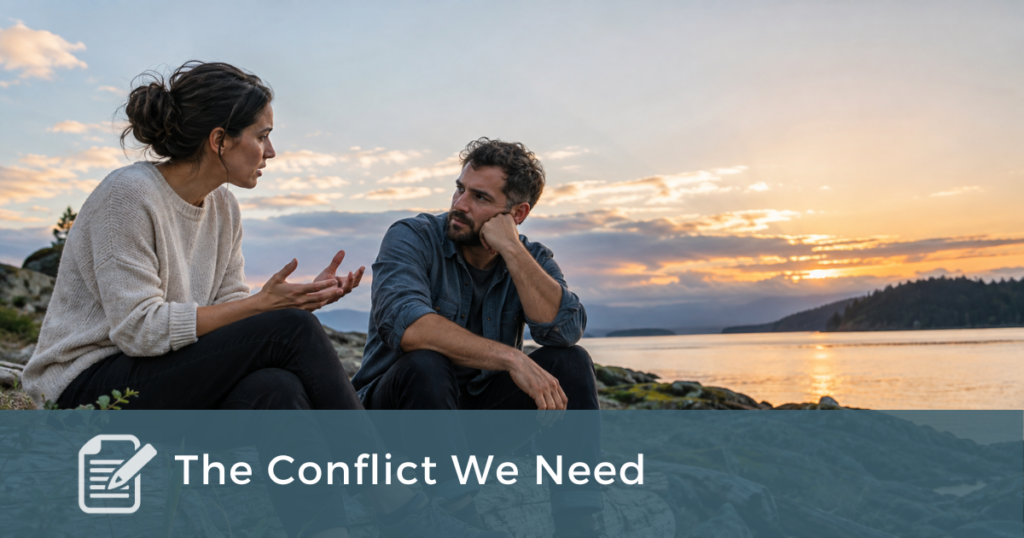
I was teaching a class that had this central idea: Healthy conflict is decision-making.
Think about that for a moment. We tend to think of conflict as something that gets in the way of making decisions. If everyone could just get along, stop arguing, and get on the same page, we could finally move forward.
But that’s not how decisions work. Decisions require us to consider different possibilities, weigh competing priorities, and wrestle with perspectives that don’t always agree. If there were no differences to navigate, there would often be very little to decide.
The problem isn’t that we have conflict. The problem is that we aren’t always willing to enter into it.
Not All Conflict Is Healthy
In our class, we talked about the importance of encouraging conflict and then helping move it from unhealthy to healthy.
That’s a different way of thinking about conflict. We often assume healthy relationships are those with very little disagreement. When conflict shows up, we assume something has gone wrong.
But there are at least two ways things can go wrong.
- Some people engage in unhealthy conflict. They become defensive, make things personal, interrupt, attack, or insist on getting their way. Their behavior makes the conversation increasingly difficult, and eventually everyone just wants it to end.
- Other people avoid conflict altogether. They don’t want to upset anyone. They don’t want another difficult conversation. They don’t believe anything good will come from it. Some have experienced enough unhealthy conflict that they’ve concluded all conflict is unhealthy, or at least unsustainable.
I understand both reactions.
At its best, conflict can be exhausting. At its worst, it can be soul-crushing.
But avoiding conflict doesn’t make the underlying problem disappear. The disagreement is still there. The decision still needs to be made. The competing priorities haven’t gone away.
Imagine a church trying to decide whether to invest its limited resources in maintaining existing programs or reaching people who aren’t currently part of the congregation. People have different convictions about what matters most. Rather than work through those differences, they avoid the conversation, and nothing changes.
Or consider two people serving together in ministry. One is frustrated with how things are going but doesn’t want to damage the relationship. So the frustration goes unspoken, gradually affecting how they work together.
The absence of conflict doesn’t mean the problem has been resolved.
Sometimes it means we’ve simply stopped talking about it.
The Courage to Have the Conversation
I led a breakout session on empowering conversations at a conference. During the keynote, the speaker challenged us to think about courage and identified several areas where we might need more of it.
As I considered the challenge, I realized that personal courage was the area where I needed to grow.
That surprised me a little. I’ve spent years teaching coaching skills and helping people navigate difficult situations, make decisions, and move forward. Difficult conversations are part of my work.
But it’s one thing to help somebody else prepare for a difficult conversation. It’s another thing to recognize a conversation you need to have and decide to have it.
Sometimes I know something needs to be addressed, but I hesitate. I wonder how someone will respond. I imagine the conversation becoming more complicated than I’d like. I consider whether it might be better to give things a little more time.
And sometimes giving things more time is wise. But sometimes it’s avoidance.
The insight that struck me was this:
When I lack the courage to engage in necessary conflict, I am condemning other people to remain stuck.
That’s a much bigger consequence than my own discomfort.
A spouse may be waiting for a conversation that could help a marriage move forward. A friend may need to hear something difficult that everyone else is avoiding. Two people may be holding on to different assumptions about a situation, neither realizing how the other sees it.
None of these situations improves simply because we refuse to discuss them.
Of course, having the conversation doesn’t guarantee a good outcome. But refusing to have it can mean that some things never get resolved.
Courage isn’t knowing the conversation will go well. It’s being willing to engage when the outcome is uncertain.
Conflict Is Part of How We Develop
I’ve been reading some interesting reflections from Nick Skytland and Andy Crouch about artificial intelligence and human formation.
One of the questions being raised is whether we can develop AI that is genuinely wise without paying serious attention to the formation of the humans developing it.
We tend to approach problems like this by establishing rules, defining acceptable behavior, and creating systems that will produce the outcomes we want.
Those things matter. But they aren’t the same as wisdom.
A person can know the rules and still exercise terrible judgment. Someone can have the right information and lack the maturity to use it well. We all know people who can explain what ought to happen but struggle when circumstances become complicated.
Formation involves something more than knowing the correct answers. It includes developing the character and judgment to navigate situations where the answers aren’t immediately obvious.
Healthy conflict is part of that process.
When we engage someone who sees things differently, we discover that our perspective isn’t the only one. We have to explain what we believe and why. We encounter information we may not have considered. Sometimes we recognize that our position isn’t as complete as we thought.
We also have to manage ourselves. Will we listen or become defensive? Will we remain curious or simply prepare our next argument?
Those experiences form us.
There’s something circular about it. We need a certain amount of maturity to engage in healthy conflict, but engaging in healthy conflict is one of the ways we develop that maturity. In other words, we need to engage in healthy conflict for the benefit of the other person.
We don’t learn patience by never encountering frustrating people. We don’t develop courage by avoiding everything that frightens us. And we don’t learn to navigate disagreement by surrounding ourselves exclusively with people who agree with us.
Some things can only be developed through practice. Others can’t practice without us.
The Conversations That Move Us Forward
This brings me back to coaching and empowering conversations.
A good coach doesn’t manufacture conflict. But neither does a good coach automatically retreat when tension appears.
Sometimes a client is holding two competing desires. Sometimes what they say they want doesn’t seem consistent with what they’re doing. Sometimes they’re avoiding a decision because making it would require them to acknowledge something uncomfortable.
The coach’s role isn’t to resolve the tension for them. It’s to create a conversation in which they can explore it honestly and take responsibility for what comes next.
That’s not just a coaching skill. It’s something we need in our families, churches, workplaces, and friendships.
We need to be able to disagree without becoming disagreeable. To listen without surrendering our judgment. To raise difficult questions without needing to control the answers.
It feels harder than it ever has in my life, but at the same time, it’s more important than it ever has been in my life.
Not every conflict can be resolved. Not every relationship is safe or healthy enough for continued engagement. And some situations require boundaries rather than another conversation.
But we shouldn’t confuse the difficulty of a conversation with evidence that the conversation shouldn’t happen.
I keep coming back to what I recognized about myself at that conference. There are conversations I need to have that I would rather avoid. And there are people who may remain stuck if I don’t find the courage to engage them.
Maybe the courage I need isn’t the courage to win an argument or convince someone I’m right.
Maybe it’s simply the courage to enter a conversation that needs to happen, without knowing exactly how it will turn out.