
My oldest brother had an away game for high school basketball. He thought my parents were going to take him home from the game, and my parents thought he was going to ride the bus. Soon, my brother was the only one left at this distant gym. A stranger noticed him, inquired about his problem, and then drove him all the way back to our hometown.
Worse than being forgotten is being abandoned. The feeling I had when my first real girlfriend told me, “Any girl would be lucky to have you. I just don’t want you.” I remember thinking no one knows me better than this one person, and she has concluded that I am not worthy. This was of course an overdramatic reaction on my part and an unfair obligation to put on a young woman, but an intense feeling of rejection overwhelmed me.
As Jesus hung on the cross, Matthew relates his last words to us: “My God, my God, why have you forsaken me?” Jesus had not been forgotten. He was being abandoned. A member of the eternal trinity, having never known a private moment in his life, was now being cut off from the presence of His father. He experienced a psychic pain that no physical pain could rival.
The story of the Gospel is about one person who refuses to leave people abandoned. (Think Prodigal Son and Good Samaritan. They are Gospel stories.) There are people around them who have a strong instinct to forsake (the priest, the Levite, and the older brother). But the one refuses to leave – and restores the lost life.
We live in a world that longs to forsake, to categorize and sort people. Good and bad. Right or left. Patriot or traitor. More and more people feel abandoned – very alone. Many wonder if anyone really cares, and for most of us, someone does, but forsakenness is thick in our culture, and it leaves everyone feeling incredibly insecure.
My thoughts return to Jesus hanging on the cross. He is in agony. He is humiliated. He is abandoned except for his mother and perhaps his disciple John. And yet, he suffers something we cannot see. His heavenly father has forsaken him, cut him completely off from his presence, left him as alone as a human can possibly be. And he wonders, “Why?”
To understand, we must peek into this unseen world and see that as every human being approaches death, they are confronted with an unbridgeable gap between themselves and their creator. Jesus is no different, but he asks a question that points us to his purpose.
This gap was created by those who came before us and expanded by us. As we leave this life and attempt to enter the next, this gap leaves us forsaken, eternally abandoned by our God, who had graciously sustained us during our earthly life.
As Jesus nears his own death, he finds himself also confronted by this unbridgeable gap, the beginning of a separation from a loving and sustaining father. Jesus cries out, “This is unfair! I’ve done nothing wrong! At least, nothing deserving of this.”
And in Jesus’ case, and only in his case, he is right. He does not deserve to be forsaken. He does not deserve to experience this final separation.
Here we find the answer to Jesus’ question, “Why?” He came to bridge that gap. He came to quench the voracious hunger of death. His pure blood, sacrificed on a humiliating instrument of death, bridged the gap so that future travelers would not end their journeys abandoned alone, so close to the promising end.
We are currently living in a low-grade hell. Loneliness is epidemic. And in a small, yet very gospelly way, we coaches can bridge that gap. Not in the grand theological way that Jesus did, but absolutely in a way that lets our client know they are not forsaken. They can be understood. They can move forward toward a life of meaning and fulfillment.
Reflecting on the cross can take us to wading into our most wretched of sins. I’ve never killed anyone or been unfaithful to my spouse, but I have made people feel small. I have been incredibly judgmental. I have selfishly put myself first when I should have advanced another. I have been jealous of the success of others, wishing it had been mine.
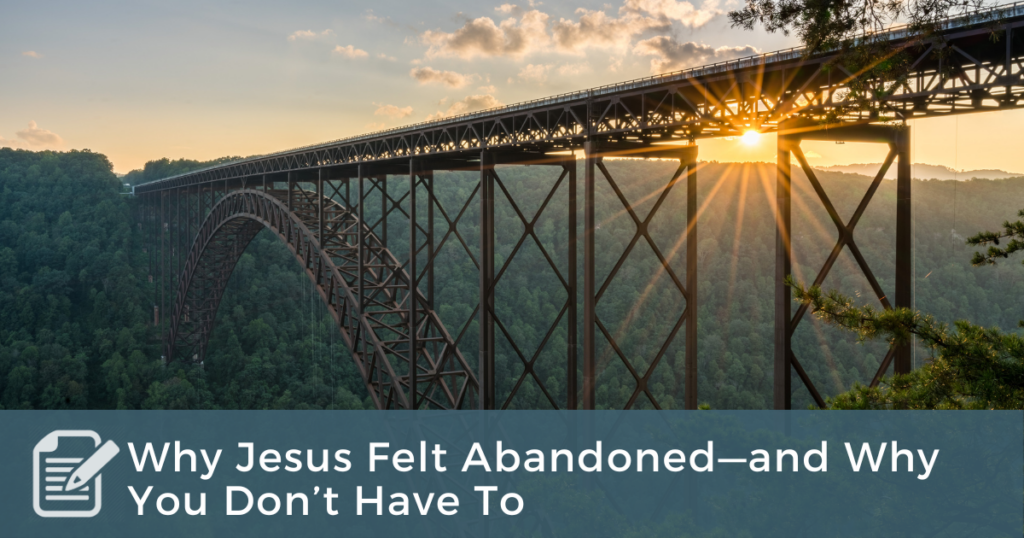
But this is not where Jesus leaves us. After three days in the grave, Jesus rises again, not just overcoming death, but more importantly, overcoming abandonment, his relationship with God the father fully restored. We are not only happy for him, but we see the construction of a completed bridge – one that will never collapse, that bridges the gap to an ultimate belonging.
Easter should leave us feeling restored, like the Prodigal Son, fully accepted, our sins forgiven and our purpose restored. We will never be alone again. Never left at a distant gym like my brother. Never the recipient of a broken heart. Never again not knowing our value and worth. Never being overlooked or forgotten.
Jesus was forsaken so that we will never be alone.