
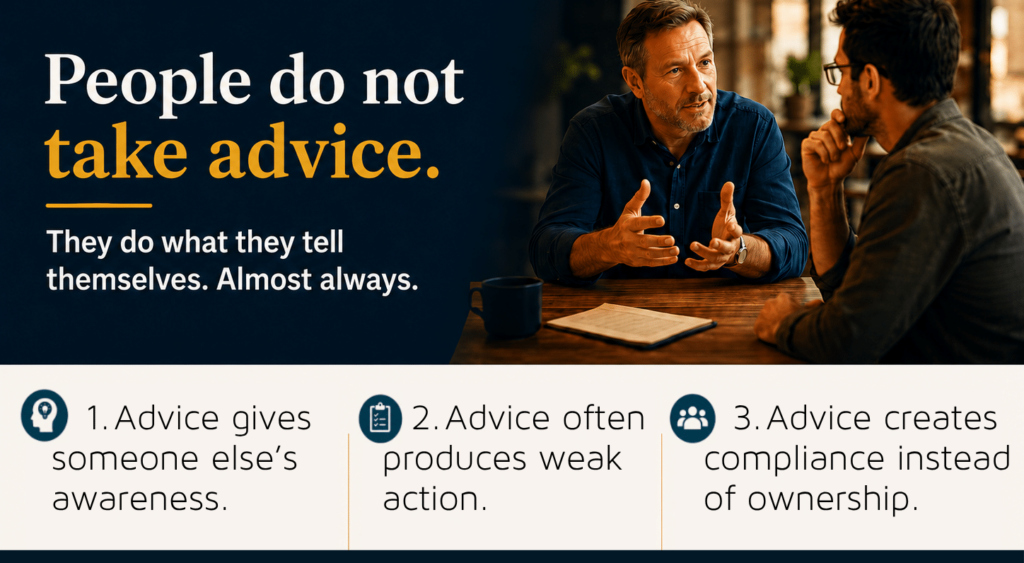
People do not take advice.
That may be too strong, but it’s more true than not. People don’t do what you tell them. They do what they tell themselves. Almost always.
If you’ve pastored, parented, led, consulted, managed, or simply tried to help someone you love, you know what I mean.
Someone comes to you with a real problem. You listen carefully. You ask a few questions. And as they talk, something becomes obvious to you. You see the next step. You see the danger. You see the thing they are missing.
So you offer advice. And sometimes it is really good advice.
Brandon told me this story about a person who worked for a nonprofit. The staff person called Brandon, frustrated and ready to quit. Not “eventually I might need to make a change” frustrated. More like, “I am done” frustrated.
Brandon listened and then gave what sounded to me like very wise advice.
Do not quit today. Stay through the fall. Do the work. Save some money. Make some plans. Build some connections. Then, at the beginning of the year, if you still need to make a move, make it in a way that is healthier for you and better for the organization.
As he told me the story, I was right there with him. I thought, “Yes. That is exactly right.”
It was practical and measured. It protected the person and even protected the nonprofit. It allowed time for planning, discernment, and transition. It was not controlling or harsh. It was good, reasonable, thoughtful advice.
Then Brandon said, “He called me the next day and told me with gusto, ‘I quit.’”
As he told me the story, it landed like a bomb. It caught me off-guard because we have all been there. We know the feeling. We gave the advice. It was good advice. It would have helped. It would have prevented unnecessary pain.
And it did not work.
Why? The problem is not simply that people are stubborn, although we are certainly capable of that. The deeper issue is that advice often skips the actual process by which people change.
A coaching approach helps us see what is missing.
First, advice gives people someone else’s awareness.
When someone tells me their problem, I become aware very quickly. I see the pattern. I see the risk. I even see the next step. I may see what they are avoiding.
But that is my awareness, not theirs.
This is one of the reasons advice fails. I am trying to give them the fruit of my awareness before they have come to awareness themselves. I may be right, but they have not owned what I see.
In Brandon’s story, the advice was probably right. The staff person would likely have been better off slowing down, planning ahead, and making a thoughtful transition. But just because you see it doesn’t mean they see it. Just because you heard them say it strangely doesn’t mean they heard themselves say it.
Good coaching does not bypass awareness. It creates space for it.
Instead of beginning with, “Here is what you should do,” coaching might begin with:
What is making you want to quit right now?
What would quitting solve?
What do you want to be true three months from now?
Those questions do not force a decision. They help a person notice what is true.
And people are far more likely to act on awareness they have discovered than awareness we have handed them.
Second, advice often produces weak action.
Even when people agree with our advice, the action may not have much strength behind it.
They might say, “That makes sense.” They might nod. They might even try it for a few days. But if the action came mostly from us, they will carry it lightly. They may do the smallest possible version of it. They comply just enough to feel like they tried.
That is not the same thing as ownership.
A better conversation helps the person build a stronger action step.
What exactly will you do?
When will you do it?
Who needs to know?
What might get in the way?
What resources do you need?
What would make this action more likely to happen?
This is where coaching becomes practical. It is not merely reflective. It does not leave people in endless self-awareness. Good coaching moves from awareness to action.
But the action needs to belong to the person.
People tend to do what they tell themselves to do. They are less likely to follow through on what we tell them to do, especially when pressure rises.
So in the nonprofit story, a coaching approach might have helped the staff person name several possible paths. Quit today. Stay three months. Have a hard conversation. Ask for a role change. Make a financial plan. Talk to a mentor. Explore options quietly. There may have been several possible actions.
But the action needed to be chosen, named, and owned by the person who would have to live with the consequences.
Third, advice can create compliance instead of ownership.
This may be the most important issue.
Advice can sometimes get someone to do what we want them to do. But even when it works, it may only create compliance.
Compliance says, “I am doing this because you told me to.”
Ownership says, “I am doing this because I have decided it matters.”
That difference is enormous.
Compliance tends to fade the first time the situation becomes difficult. Ownership has a much better chance of lasting because the person has connected the action to their own values, responsibility, and future.
Remember what my friend Bill said? “No one ever washes a rental car.” Why? Because it is not theirs.
The plan may be good, but if it still feels like your plan, the other person will not take care of it. They will not wash it. They will not maintain it. They will definitely not protect it when things get hard.
Coaching helps the person say, “This is mine.”
This is my situation.
This is my decision.
This is my responsibility.
This is my next faithful step.
That is why coaching is so powerful. It helps people move from awareness to action to accountability. It helps them not only decide what to do, but also determine what will help them actually do it.
And that is the part advice often misses.
I talked more about this in a recent podcast, but the basic idea is simple: advice often gives people our awareness, our action plan, and our sense of responsibility. Coaching helps them develop their own.
This does not mean we never give advice. There are times when advice is appropriate. There are times when expertise matters. There are times when someone simply needs information.
But many of the conversations that matter most are not information problems. They are ownership problems.
The person does not merely need to know what could be done. They need to become ready to do what is theirs to do.
That is why I care so much about coach training.
CAM 501, Foundations for Christian Coaching, begins August 6. I will be teaching it for eight weeks. It is not merely a class about asking better questions, though you will certainly learn to ask better questions. It is a place to practice transformational conversations.
You will learn how to help people come to awareness. You will learn how to help them craft meaningful action. You will learn how to help them build accountability so the action has a better chance of becoming real.
Because people around us need more than advice.
CAM 501 may be for you if you want to become more intentional and skillful in the conversations already entrusted to you. And if someone came to mind while you were reading this, would you forward this email to them? It might make all the difference.
People need conversations that help them notice what is true, name what matters, and take responsibility for the next faithful step.
The next time someone brings you a problem, you may know exactly what you would do.
Pause before you say it. Ask what they are noticing. Help them name what they want. Invite them to choose the action they are willing to own.
That kind of conversation may do more than solve the problem in front of them.
It may help transformation begin.